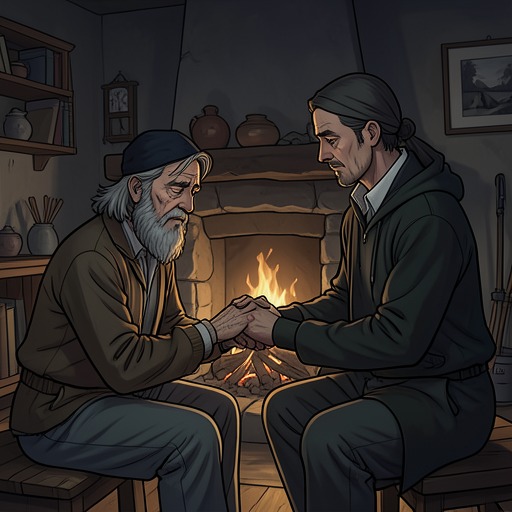
Pip and Biddy’s friendship
Great ExpectationsPip and Biddy’s friendship is a lasting bond of learning, candor, and practical affection, strained by Pip’s pursuit of gentility but not erased by his absence or mistakes. Biddy offers him both education and honest companionship; later, when he returns humbled, their closeness is tested by his unspoken hope of marrying her and steadied by her marriage to Joe. The relationship’s final shape is neither romantic union nor estrangement, but a friendship that survives because Pip comes to recognize the care and loyalty he had once taken for granted.
Identity and Early Foundation
Biddy enters Pip’s life as an intelligent, obliging companion who helps him improve his learning. After his visit to Miss Havisham’s house unsettles his sense of himself and his place in the world, Pip decides that becoming “uncommon” requires acquiring knowledge. He asks Biddy to share what she knows, explaining that he has a particular reason for wanting to get on in life. She readily agrees and begins teaching him almost at once. Their friendship is thus established through generosity and shared study, but also at a moment when Pip’s ambitions are already turning toward distinction.
Pip’s childhood has made him unusually alert to unfairness. Recalling his sister’s harsh upbringing of him, he says that a child can feel injustice acutely even when the world around the child is small. This history helps explain why Biddy’s willingness to teach and listen matters: she is not simply another authority over him, but a companion with whom he can speak and learn. His later account is retrospective, and it repeatedly corrects the younger Pip’s judgments; the friendship is seen both through the boy who misreads his home and the adult narrator who understands what he was given.
Ambition and Estrangement
The day Pip visits Miss Havisham and meets Estella marks a change in his sense of his home and future. As he later recognizes, a single memorable day can form the first link in a chain that alters a life. He becomes ashamed of the forge and of the ordinary life he had once imagined sharing with Joe. That shame reaches beyond Joe: as Pip’s expectations rise, he grows gloomy even while Joe and Biddy congratulate him, and he mistakes their affectionate attention for possible mistrust. The narrator acknowledges that neither had accused him; the suspicion belongs to Pip’s own changed state of mind.
When Pip returns to the village after losing the expectations he had built his future around, he imagines approaching Biddy as a penitent suitor. He plans to tell her that he has lost what he hoped for, recall their former confidences, and ask whether she could accept him despite his faults and disappointments. He would let her decide whether he should work at the forge, seek another occupation nearby, or go elsewhere for an opportunity he had previously set aside. His imagined proposal entwines affection with the wish to be forgiven and to begin again. Yet it remains only a purpose: Pip does not tell Biddy this before discovering that she has married Joe.
Return, Marriage, and Recognition
During Pip’s recovery, Joe and Biddy arrange their care with tact. Joe avoids pressing Pip about matters he would rather keep private, while Biddy has understood his circumstances and prepared Joe to respond kindly. Pip is deeply affected by their consideration, though he cannot tell whether Joe understands how completely his expectations have dissolved. He also notices that as his strength returns, Joe becomes less at ease in their former intimacy. Pip recognizes the reason: his earlier coldness had given Joe grounds to fear that prosperity would make him abandon their bond. The estrangement was not an absence of affection but a consequence of Pip’s own conduct.
When Pip eventually returns to the old home, he learns that Biddy and Joe have married. Biddy announces the news with happiness, and the two welcome Pip with such delight that his accidental arrival completes their wedding day. Joe’s restoring touch and Biddy’s hand in Pip’s make the reunion a scene of family tenderness rather than reproach. Pip is thankful that he never voiced his last hope of marrying Biddy: had he done so during his illness, Joe would have known of it. The revelation therefore closes the romantic possibility he had privately entertained while preserving the friendship from an unnecessary wound.
Friendship After Disappointment
Pip’s affection for Biddy remains evident, but he accepts the life she has made with Joe. He tells her that Joe is the best husband in the world and recognizes that Biddy could not love him more. Their ease with one another is carried into the next generation: Pip asks to take Biddy’s young son, also named Pip, for a walk and later asks whether Biddy might let him have the child with him one day, or at least lend him to his care. Biddy answers gently that Pip must marry. Her response, and the wedding ring whose light pressure he notices, make clear the boundary between his affection for her and her established marriage.
Biddy also asks whether Pip still grieves for Estella. He says that nothing which once held a foremost place in his life has been forgotten, but that the old dream has passed. Even as he speaks, he privately intends to revisit the ruined house for Estella’s sake. This lingering attachment shows that Pip’s return to Biddy does not erase his earlier emotional history; it does, however, let him speak with her as an old friend rather than demand that she repair his disappointments. His admission and her question belong to a relationship in which familiarity allows candor without requiring possession.
Continuity and Significance
After the reunion, Pip sells what he owns, arranges time to repay his creditors, and leaves England to join Herbert. He begins work with Clarriker and Co., lives frugally, repays his debts, and maintains a constant correspondence with Biddy and Joe. The distance does not end their friendship: it becomes a continuing connection sustained through letters and renewed contact, rather than through daily life in the village. Pip’s work and financial recovery also contrast with the social elevation he once imagined; his later life is shaped by labor, responsibility, and the friendships he retains.
The bond’s significance lies in the distinction between aspiration and care. As a boy, Pip treats his home and its people as evidence of a status he wants to outgrow; as an adult, he can return without pretending that his hopes were fulfilled or that he never hurt those who remained loyal to him. Biddy is neither a reward for his remorse nor a substitute for Estella. She is an independent friend whose marriage to Joe is welcomed by Pip, and whose continued presence gives his changed life a human continuity. Their friendship endures not because the earlier estrangement is undone, but because Pip learns to acknowledge it, accept its consequences, and remain connected without claiming more than Biddy offers.